
08 / LAW ENFORCEMENT & GOVERNMENT

Advanced mobile research. In your environment.

Support specialist law enforcement and government teams researching mobile platforms, native components, and complex vulnerability paths. Connect reverse engineering, coverage-guided fuzzing, and device-based validation in one research workflow.

  1. 01
    RESEARCH BRIEFComponent, environment, and target behavior
  2. 02
    RESEARCH LABDecompile, trace, and build a harness
  3. 03
    FUZZ + VALIDATECoverage feedback and device reproduction
  4. 04
    YOUR RESEARCHERSRoot cause, test case, and runtime evidence

NATIVE RESEARCH / COVERAGE-GUIDED FUZZING / PRIVATE LABSSourceRuntimeEvidence

MOBILE SECURITY USE CASES FOR PUBLIC-SECTOR RESEARCH

Build a research capability that goes deeper than a scan.

Specialist teams need to investigate how a component behaves, develop useful experiments, and explain the evidence behind a finding. Djini brings AI-assisted investigation and an integrated device lab into that work, with enterprise deployment options for your environment.

01 / Industry use case

Investigate native mobile attack surfaces

Complex vulnerabilities in native code and mobile components require more than pattern matching. Researchers need to follow execution and test specific hypotheses.

Explore the workflow →

How Djini does the work

Ask Djini to help investigate a native library, parser, or mobile component through reverse engineering and runtime tracing. Develop a targeted fuzzing harness, use coverage feedback to guide experiments, and investigate reproducible crashes with the research team.

The outcome for your team

Component-level observations, harness and test-case artifacts, crash context, and a reproducible basis for assessing root cause and security impact.
02 / Industry use case

Reproduce research on controlled devices

A finding can depend on the app build, OS version, architecture, or device state. Your lab needs to capture those conditions and repeat the experiment.

Explore the workflow →

How Djini does the work

Run research workflows on supported virtual devices or connected physical hardware. Use Device Lab’s execution, shell, file, and API capabilities to reproduce behavior and compare experiments across agreed environments.

The outcome for your team

Recorded device context and repeatable execution with the runtime observations and artifacts your researchers need to review the result.

03 / Industry use case

Operate a private research capability

Research teams need to account for source material, binaries, model requests, and findings when designing their operating environment.

Explore the workflow →

How Djini does the work

Scope private cloud or on-premise Djini deployment with approved inference, a defined device fleet, and the integrations your team requires. Consider local models and custom fine-tuning to reflect your organisation’s research knowledge.

The outcome for your team

An enterprise deployment plan covering data processing, model choice, device capacity, and a practical first research evaluation.

YOUR FIRST EVALUATION

Start with a component your researchers know.

Choose a representative mobile component and a known research question. Evaluate how Djini supports reverse engineering, harness development, and runtime reproduction before expanding to a broader research programme.

Start with the first workflow →

Target compatibility, supported OS versions, device capacity, and deployment dependencies are confirmed for the evaluation.

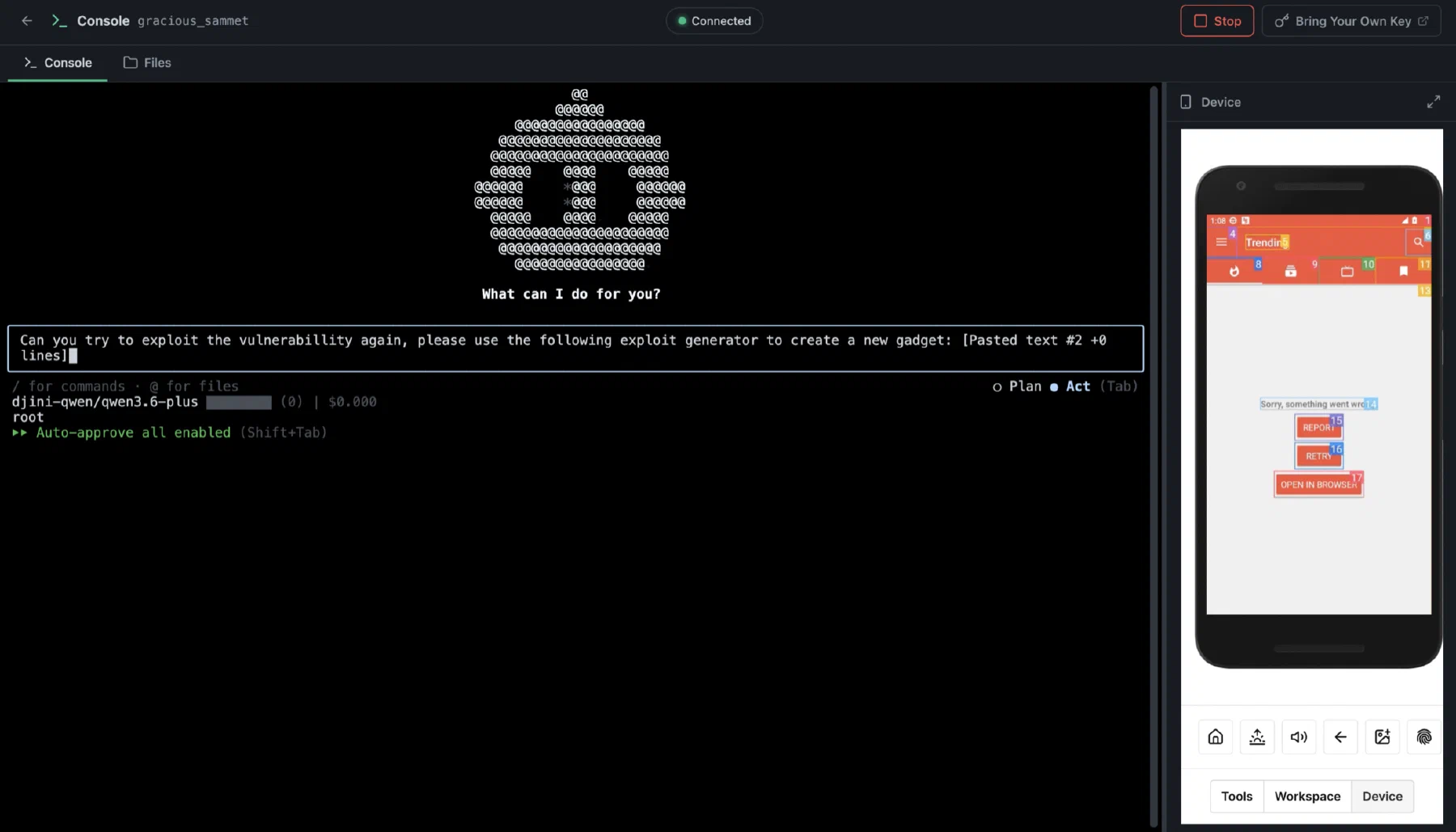
The Djini agentic console driving a connected Android test device

Build your workflow · All Djini use cases →

A few good questions

Before you go deeper.

Is this only an application vulnerability scanner?

No. The research workflow also covers binary investigation, native-code analysis, fuzzing harness work, and device-based validation. The evaluation is scoped around your target component and the research tasks your team needs to perform.

Can we use local models and our own infrastructure?

Discuss an on-premise or private-cloud enterprise deployment with local or approved model endpoints. The device environment, inference, and external integrations must be designed together to meet your processing requirements.

Can our existing research tools and devices be used?

Device Lab provides API-based integration and support for compatible virtual and physical devices. Bring your tooling and hardware requirements to the scoping discussion so compatibility and the execution workflow can be assessed.

DJINI FOR LAW ENFORCEMENT & GOVERNMENT

Your next research question. A connected lab to investigate it.

Connect the code, the device, and the question your team needs answered.